Jenny Kane: Coffee, cupcakes, chocolate and contemporary fiction / Jennifer Ash: Medieval crime with hints of Ellis Peters and Robin Hood

Tag: Greece

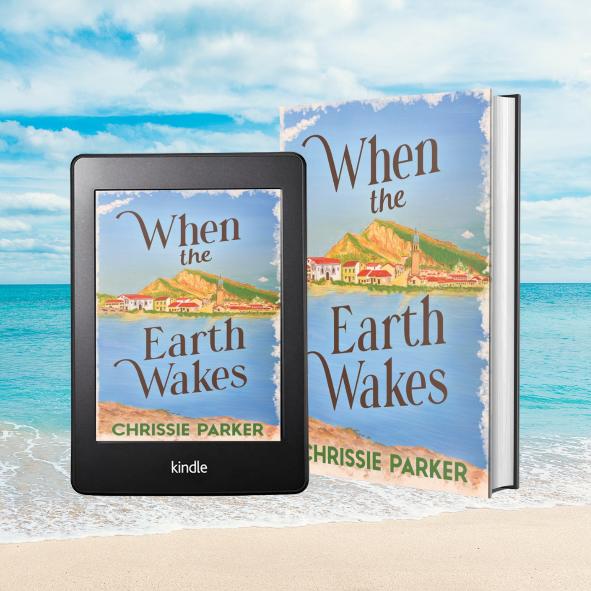
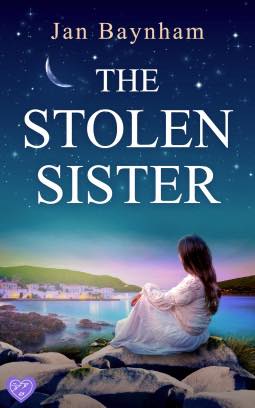
Opening Lines with Jan Baynham: The Stolen Sister

I’m welcoming the super lovely, and ultra-talented, Jan Baynham to my place today to share the #openinglines from her brand new novel: THE STOLEN SISTER

Thank you for inviting be back to your lovely blog, Jenny.

Introduction

The Stolen Sister is my sixth novel. It has all the features which readers are coming to expect of my books – a dual timeline, contrasting locations, family secrets and two love stories. In this novel, there is also the theme of grief, resilience, sibling relationships, romantic love, a search for identity and reconciliation. It’s set in beautiful Crete in 1963 and again twenty years later, as well as rural mid-Wales. The Stolen Sister is the story of Greta, a young Welsh painter who arrives in the fictional town of Fáros Limáni to join an art commune. In 1984, her daughter Zoë travels to Crete to carry out her mother’s dying wish to have her ashes scattered into the sea there even though she knows nothing of her mother’s connection with the island. Through my words, I hope I’ve been able to take the reader on a virtual trip to this stunning island, as seen through Zoë’s eyes as she returns to the place of her birth for the first time.

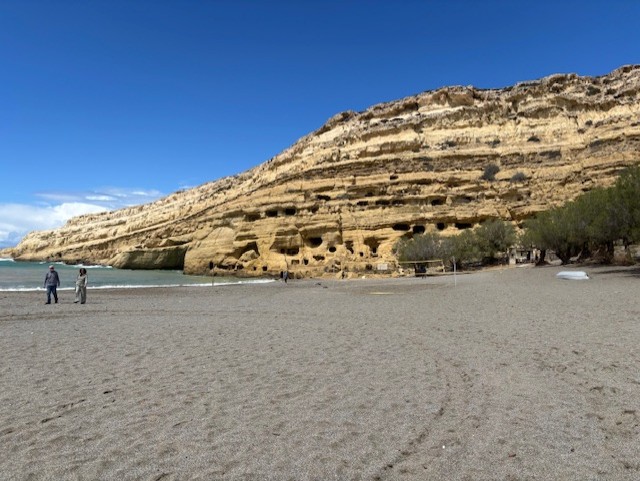
Matala caves

Blurb

Lost letters. A secret Greek love affair. A daughter’s search for the truth.

Crete, 1963. Young artist Greta Ellis arrives at the sun-soaked port of Fáros Limáni, ready to paint and explore the beautiful Greek island.

There she meets passionate local, Andreas Papadakis, and Greta is swept up in a world of colour, freedom and forbidden love. But when tragedy strikes, Greta is forced to make an impossible choice that will change the course of her life — and her heart — forever.

Wales, 1984. After the death of her beloved mother Greta, silversmith Zoë Carter receives a sealed letter that upends everything she thought she knew. Greta’s dying wish is for her ashes to be scattered in Crete, a place precious to her . . . but somewhere she had never spoken of.

Searching through her mother’s belongings, Zoë uncovers a series of letters. Written in Greek and dated the year before she was born, they reveal a passionate love affair. And a tragedy that tore it apart.

Determined to know the truth, Zoë travels to Crete to follow the trail left behind in her mother’s letters. Through the olive groves and whitewashed villages of Crete, she begins to piece together a story of love, betrayal and loss — and discovers that her family was never what it seemed.

Perfect for fans of Lucinda Riley, Kate Morton, Dinah Jefferies, Santa Montefiore, Fiona Valpy, Barbara Davis, Angela Petch, Karen Swan or Anita Chapman.

First 500 Words

Prologue

North West Crete, 1967

Greta forced herself to smile as she watched her handsome new husband join in with the traditional Greek dancers, his blue eyes sparkling as he swayed his hips and dipped in time with the others as they circled the dance floor. The haunting sound of the bouzouki music filled the busy taverna above the noise of the fun and laughter of the diners. Since arriving in Crete four years before as a naive art student, she’d heard the instrument played many times but tonight there was something unnerving about the music. It seemed dissonant to her. Something wasn’t right.

She quickly dismissed the feeling when her three-year-old daughter wriggled down from her lap.

‘Me dance, too.’ Even though she could hardly keep her eyes open, the little girl ran towards the dancers who stopped and clapped, welcoming a laughing Greta and her daughter to join John in the circle. They all sidestepped and dipped, then kicked each leg in time to the music.

The meal at the taverna, situated a few miles out of Fáros Limáni, was to celebrate John joining his wife and daughter to make a new life together and to thank their American friends, Bill and Nancy, who’d helped them settle. John had left his temporary teaching job in Heraklion for a permanent post close to where they were going to live.

Returning to sit down at the table, Greta pulled the little girl onto her lap, loving how she snuggled into her and fell asleep, safe in her mother’s arms. She always looks so like her father as she sleeps. The same long dark lashes, the same beautiful face.

She looked at a smiling John, sitting next to her. How she loved her new husband! She couldn’t believe how lucky she was that life was good again . . . so why did she have a niggle of foreboding?

‘Someone’s exhausted. Shall we go?’ John stood and held out his arms to take the little one from Greta. Bill and Nancy stood to go with them.

They took the coastal road back to the port. Relieved John was driving slowly round such sharp bends and that the road was deserted, Greta relaxed into the seat behind him.

‘Not far now, sweetheart.’ John glanced in the rear mirror at the little girl fast asleep between Greta and Nancy.

A wall of rock loomed in the headlights.

Greta screamed. ‘John!’

John yanked the steering wheel in order to try to take the hairpin bend he’d been distracted from. ‘Holy shit! Hold on!’ Searing pain shot through the whole of Greta’s body as the car crashed into the cliff. She heard the thud of John’s head slamming down onto the centre of the steering wheel. Unable to move, deafening noise engulfing her — screams, the horn blaring continuously, her daughter wailing, panic in voices.

‘Oh, God.’ Bill shook his friend. John didn’t respond even as Bill shook him harder. Choked, he said, ‘I’ll get Greta out first. You lift the…

Here are some of the amazing reviews for Jan’s incredible work.

⭐⭐⭐⭐⭐ ‘The most compelling, evocative, heart-wrenching book I have ever read.’

⭐⭐⭐⭐⭐ ‘Captivating and emotional . . . A top, top, must-read.’

⭐⭐⭐⭐⭐ ‘One of the best sagas I’ve read in a very long time.’

⭐⭐⭐⭐⭐ ‘A novel that will transport you to Greece, with its sensory delights of sights, sounds and flavours.’

⭐⭐⭐⭐⭐ ‘The vivid imagery used to paint Greece is stunning and made me feel as if I was there. If you enjoy a multi-layered novel brimming with secrets, you’ll adore this story.’

⭐⭐⭐⭐⭐ ‘Historical fiction at its best.’

You can buy The Stolen Sister from all good retailers, including:

Amazon UK – https://www.amazon.co.uk/Stolen-Sister-powerful-emotional-historical-ebook/dp/B0GN9Z34YH/ref

Amazon US – https://www.amazon.com/Stolen-Sister-powerful-emotional-historical-ebook/dp/B0GN9Z34YH/ref 

BIO

Originally from mid-Wales, Jan lives in Radyr, on the outskirts of Cardiff. After retiring from a career in teaching and advisory education, she now writes historical fiction and sagas. Fascinated by family secrets and ‘skeletons lurking in cupboards’, Jan writes dual narrative, dual timeline historical novels that explore how decisions and actions made by family members from one generation impact on the lives of the next. Setting and a sense of place play an important part in all of Jan’s stories and as well as her native mid-Wales, there is always a contrasting location in sunnier climes. She is published by Joffe Books/Choc Lit. She enjoys meeting up with other writers, especially members of her local Cariad RNA Chapter as well as when attending talks and workshops.

X- @JanBaynham https://twitter.com/JanBaynham

Facebook – Jan Baynham Writer https://www.facebook.com/JanBayLit/?locale=en_GB

Instagram – janbaynham https://www.instagram.com/janbaynham/?hl=en-gb

Threads – https://www.threads.com/@janbaynham

Blog – Jan’s Journey into Writing https://janbaynham.blogspot.com

Amazon Page – Jan Baynham https://www.amazon.co.uk/stores/Jan-Baynham/author/B085DC6BKR?ref 

Many thanks for sharing your work with us today, Jan,

Happy reading,

Jenny xx

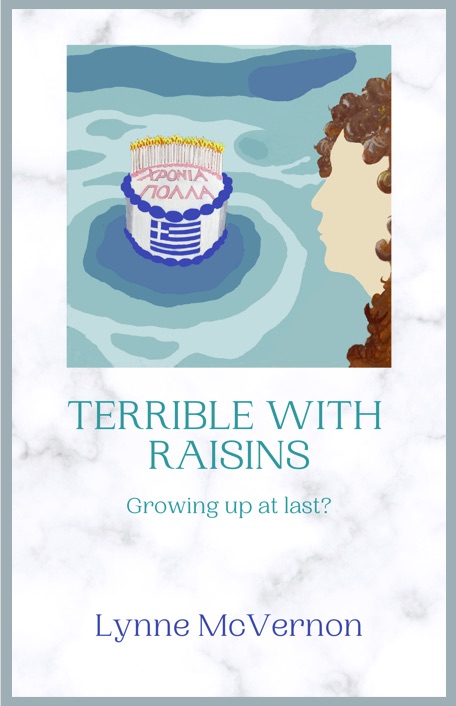
From Raisins to Jigsaw Island: Lynne McVernon

I’m delighted to welcome fellow author and friend, Lynne McVernon to my place today, to give us an insight into her life and her two novels, Terrible with Raisins and Jigsaw Island.

Grab a cuppa, put your feet up, and have a read.

Over to you Lynne…

One of my husband, Martyn’s, fondest claims is that he’s slept with a woman who hugged a man who slept with Marilyn Monroe. Quite a glamorous three degrees of separation but not strictly true. Reassuringly, the woman he refers to sleeping with is me. The other man is playwright Arthur Miller. And Arthur Miller, as you may know, was Miss Monroe’s third husband. But I didn’t so much hug him as run smack into him while lost in the backstage corridors at the National Theatre. He was a very tall man, I remember, and quite laid back about the collision.

It’s one of many theatrical anecdotes amassed over 25 years’ work encompassing a range of activities from sweeping the stage to directing. As the daughter of a playwright, writing and theatre were instilled in me from birth. So my career was one of director and writer, directing devised, co-written and self-penned material plus everything from Ayckbourn to Shakespeare in regional rep, the Young Vic and the National. I mounted a writers’ festival in Tayside, and founded a young people’s creative writing/performance company, Fable Productions, in Berkshire. With drama students, I devised/co-wrote a complex play, A Country Wedding, based on the life of Peter Breughel, which played at the Edinburgh Festival Fringe, 1985. I also adapted three Dickens novels for Guildford School of Acting, possibly my favourite experiences.

So why am I not doing it these days? Why novels instead of plays? Theatre is a very demanding profession, with periods of unemployment, constantly changing conditions and steep challenges. To be honest, the 70s to 90s weren’t that welcoming to female directors. Very few survived. I’m glad to note women’s opportunities in the field have changed considerably. But for me, back then, it all became too much. Again, over that period, mental health was given comparatively short shrift. I struggled with bottomless bouts of despair for many years. Once, I took a rehearsal while convinced my head was changing shape. At least twice, I went down to a dress size 8 – and I’m 5’ 9”. All that, and a crumbled marriage, made me realise I couldn’t live with it any more.

Serial jobs supported me to write. Some, apart from teaching, which I love, could be fairly dispiriting as I felt like a ‘stranger in a strange land’. Publishing my first novel in 2013 was the first project I’d completed for years. A friend vanished for a long weekend on her fortieth birthday to ‘leave behind all the crap of the last forty years’ and start again. ‘Great idea’ I thought, and, being on the way to fifty myself, wrote about a woman who tries to escape her fiftieth birthday in Greece. Et voilá, Terrible With Raisins. It squeaked in just before I reached my sixtieth. It’s taken seven years to produce the second novel, ‘Jigsaw Island’.

I must be improving as a writer because I’ve had a couple of prizewinning short stories and may even publish an anthology. Still humming and hah-ing on that one. The next novel is probably halfway there. Three others are festering in drawers. Jenny Kane has been a great mentor and, as far as I’m concerned, friend. I am in awe of her output!

Martyn is a wonderful supporter of my writing, an exacting proofreader and has worked with me on the cover designs for the release of Jigsaw Island and the re-release of Terrible With Raisins.

Writing is my passion, a compulsion and a therapy. It’s also saved my life. I tend to have more good days than bad, but lockdown has been difficult for everyone and the gremlins surface. If you’ve been reticent about your depression or anxiety , or both – they’re fairly unpleasant companions – maybe it’s time to share. Do if you can. And if you’d like to talk to me – I’m here to listen – and I mean listen. lynne@lynnemcvernon.com

Website: https://lynnemcvernon.com/

Facebook: Lynne McVernon – Author Twitter: @lynnemcvernon

One anecdote before I go. I was once ‘on the book’ (prompt book) for a production of Macbeth in Worthing. One night, Lady Macbeth walked on for the sleepwalking scene, stopped, then shuffled off backwards, candle and all. My heart stopped. Almost immediately, she reappeared and the scene went ahead as chillingly as it should. Afterwards, the actress confessed that she’d gone three paces on, remembered she was wearing flip flops, thought ‘Lady Macbeth wouldn’t wear flip flops’ went back to the wings and kicked them off. She was my dear friend, the late Shirley Stelfox, whom you may, perhaps, remember as (many years later) Edna Birch in Emmerdale.

The novels: Paperbacks are available mid-July 2020.

BLURB – TERRIBLE WITH RAISINS – Growing up at last?

Clair knew what was coming, ‘…something pretty terrible…Not just plain terrible. This was fancy terrible. This was terrible with raisins in i.t’. From ‘The Middle or Blue Period’, Dorothy Parker

There’s a big birthday looming. Clair tries hiding from it on the Aegean island of Symi, Greece. Inevitably it catches up with her. But so do a couple of possibilities, interesting, attractive ones…Encouraged, she departs the Greek idyll to face the reality of her demanding daughter, her hypercritical mother, and the special person in Scotland who keeps her sane. But there’s a secret she keeps from them all. In the coming year, she will swallow a lot of raisins, sweet and sour, in England, Scotland and Florida. She will discover plenty – forget a few things (it was a BIG birthday), and, reluctantly, reveal her secret. Mother, daughter, niece, lover, reluctant teacher and neglected artist – will the real Clair Harkin please grow up?

Read a chapter here  Buy eBook

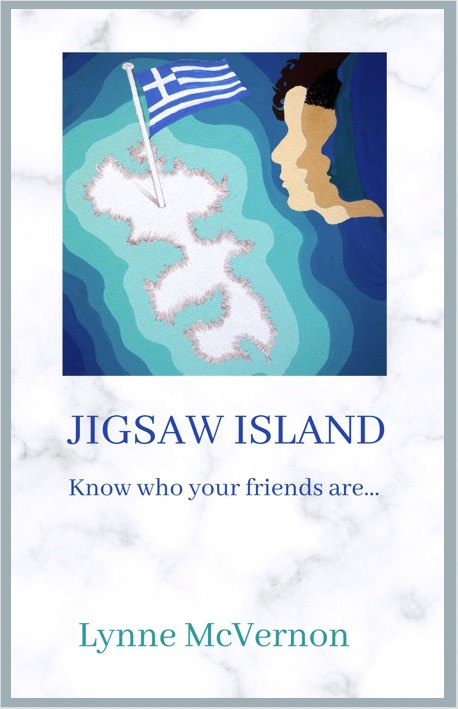
BLURB JIGSAW ISLAND – Know who your friends are… (released 30 June 2020)

On a holiday escape to the Greek islands, Annie Buchanan discovers what – and then who – is missing from her life…

When single mother, Annie, and son Jude take a break away from Scotland to stay with her brother and friends on the Greek island of Symi, they find the warmth and support they need. As they ease into the relaxed rhythm of life there, old and new acquaintances change the course of their vacation. Whether it’s for better or worse, Annie will discover when she visits the island of Leros. There she may be able to put together some of the missing pieces in her life and learn who her friends really are. But she cannot be prepared for some uncomfortable truths about the past and the dramatic way in which they will change the present for her… and Jude.

Read a chapter here   Buy Ebook 

***

Many thanks Lynne.

Happy reading everyone,

Jenny x

Interview with Rebecca Hall: Girl Gone Greek

I have a brand new visitor to my blog today, the lovely Rebecca Hall. Not only is Rebecca a travel writer, she has also written a novel about her adventures in Greece.

Why not grab a cuppa, pull up a chair, and put your feet for five minutes, and join in our chatter…

coffee and cake

What inspired you to write your book?

I lived in Greece for a while, teaching English. Now I divide my time between this beautiful country and the UK.  At the time (about 2010), Greece was going through a lot of negative press (and still is, to a certain degree).  It made me angry because what was being represented was not the Greece I knew, and not a true representation of the people I knew.  It insulted me to hear my adopted countrymen being accused of being lazy, insolent and the root of all the problems in the E.U. And so I set about writing, in novel format, my experiences of the Greece and her people.  I wanted to make it humorous and bring the characters to life, for people to see another side to Greece…one very much absent from the press.

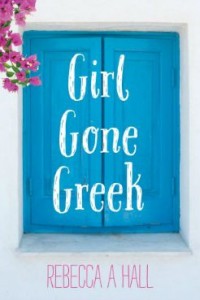
GGG resize to 80

Do you model any of your characters after people you know? If so, do these people see themselves in your characters?

Absolutely! Girl Gone Greek is ‘faction’ really (fact in fiction format) and is based on my first year living in a remote Greek village as an EFL teacher.  The head of the school, the other teachers and the protagonist’s best friend all have character traits of people I’ve met, interacted with and developed friendships and relationships with.

Kaliopi, the best friend, was certainly modeled on my best Greek friend. And the real Kaliopi doesn’t mind at all.  She actually thanked me for highlighting elements of her character and psyche she never realized existed! (I hurriedly told her it was fiction so an element of poetic license was involved, but she seemed pleased nonetheless).

What type of research did you have to do for your book?

Much of Girl Gone Greek was taken from my own personal experiences.  I also included historical references to Greece’s past, especially about the (only quite recent) dictatorship in the 1970’s, a couple of references to specific events in Athens during World War II and recent events during the current troubled economic times.

For recent events, I was in Greece myself so I could ask my Greek friends to help me understand. The specific Dictatorship and World War II references are common knowledge to all Greeks, young and old so first hand accounts were quite easy to come by, luckily.  I was lucky to be able to get primary research.

Do you prefer to plot your story or just go with the flow?

Definitely the latter – just go with the flow. I am not a ‘rigid’ person generally and find following strict guidelines and rules in general in life very restricting (hence why I love the semi-chaos of Greece). Although maybe I should actually try to set myself a timeline and plot in advance because it took me a long time to write, learn about and then self-publish Girl Gone Greek.  And it’s also taking me a long time to get into the groove of writing my follow up novel.  Maybe if I had a deadline, this’d help me to discipline myself.

What excites you the most about your book?

The fact that it seems to excite others to want to come and experience another side to this wonderful country, with its aesthetic beauty and kind hearted people.   Lovers of Greece had left me reviews and / or emailed me personally to thank me for what I’ve written and for showing the humane side.  Greeks have thanked me for showing their country in a different light and for understanding their quirks.  It excites me to feel I can offer this to my adopted countrymen: make a difference to the way people view Greece, at least to the small percentage of people who read and like my book enough to want to explore more.

Anything else you’d like to share with us?

Girl Gone Greek is a humorous fictional, yet honest account of one woman’s experience in a small Greek village. The Greek people encountered every day in this country are enough to write a novel in itself! Drama is originally a Greek word – and there is enough drama in Greece to write many novels, even non-fiction!  But the Greeks know how to survive, and with it, offer philotimo (not a word, but a concept, meaning offering friendship to strangers).

I hope you’re encouraged to visit Greece and create your own Greek story.

***

Links

Website: www.lifebeyondbordersblog.com

Facebook: www.facebook.com/AuthorRebeccaAHall

Facebook: www.facebook.com/LifeBeyondBordersBlog

Twitter: www.twitter.com/BeyondBex

Instagram: www.instagram.com/BeyondBex

Google +: https://plus.google.com/+BexHall

Pinterest: www.pinterest.com/BeyondBex

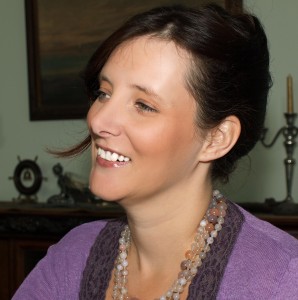
OLYMPUS DIGITAL CAMERA

Bio

Girl Gone Greek is Rebecca Hall’s debut Contemporary Women’s Fiction Novel – available on Amazon.

After extensive global travels, Rebecca left the UK to return to the country she fell in love with—Greece, where she teaches English, writes and wryly observes that the chaotic nature of her adopted country actually suits her personality very well. All travel experiences, & particularly living in versatile cultures, have helped to shape who she is today. She is a Rough Guide co-author (Greece & The Greek Islands and Portugal) and has contributed to numerous publications including Apollo Business Class Magazine for Cyprus Airways and Let’s Go for RyanAir, the Daily Telegraph Travel Section and her container ship voyage from Athens to Hong Kong caught the eye of NPR National Radio in the United States, where she was interviewed twice.

When not writing, you’ll usually find her drinking coffee with friends, or sourcing a new place to eat baklava.

***

Many thanks Rebecca. Excellent interview.

If you are in the South West, and want to meet Rebecca in person, she will be talking at this year’s Tiverton Literary Festival (8th-12th June)- details coming soon.

Happy reading everyone,

Jenny x


Powered by WordPress & Theme by Anders Norén