Jenny Kane: Coffee, cupcakes, chocolate and contemporary fiction / Jennifer Ash: Medieval crime with hints of Ellis Peters and Robin Hood

Category: crime Page 18 of 24

End of March madness from Nell Peters

It’s that time again…I’m handing over to Nell Peters for her end of the month round up. Hope you’ve got a cuppa on standby…

Over to you Nell…

Oh hi! It’s you again! Nothing better to do? Well, you’d better come in, I suppose – but you’ll have to make your own tea, because I’m involved in matters of national importance. Not all of that is true …

So, did March come in like a lion, go out like a lamb? Rather depends upon where you live, I imagine. The saying is obviously based on northern hemisphere weather variance at this time of year, originating from times when the land dominated peoples’ lives and bad weather could trigger food shortages, putting whole communities at risk. It was believed that bad spirits could affect the weather adversely, and so everyone watched their Ps and Qs, trying not to upset the little devils.

March can be a changeable month, in which we experience a huge range of temperatures and conditions, but it’s also a month that hints at spring turning to summer and better weather to come. I’m always thrilled to see daffs in Tesco, with at least the promise of those and other bulbs’ brave green shoots raising their tips above the parapet of soil, where they’ve snoozed over winter. Lambs frolic in lush green fields (cue ooh-ah sounds, or maybe ooh-baa?) and baby birds hatch in their nests, beaks ever-open demanding food from their poor overworked/underpaid mothers. All in all, a hopeful time of year, especially after the vernal (spring) equinox – Monday 20th in 2017. Apart from lion/lamb lore, lesser-known predictions are: Dry March and a wet May? Fill barns and bays with corn and hay. Or: As it rains in March so it rains in June. Then we have: March winds and April showers? Bring forth May flowers. Genius.

There are two saints’ days in March; David (1st) and Patrick (17th), plus Mothering Sunday/Mother’s Day (26th in the UK 2017, the fourth Sunday in Lent) – and, occasionally, Easter; but not this year. Far more interesting though are National Peanut Butter Day and National Pig Day (perhaps referring to those who scoff more than their fair share of peanut butter?), celebrated on March 1st in the USA – where else? – and they follow that up with National Crème Pie Day (3rd), National Peanut Cluster Day (8th), National Crab Meat Day and National Meatball Day (9th), then National Blueberry Popover Day on the 10th. After that, there’s a bit of a digestion-resting lull, when any self-respecting American books on SAS (Scandinavian Airlines, not the scary military lot) and nips over to Sweden for Waffle Day on the 25th.  Then it’s back home to wash down all that junk food on the 27th, National Whiskey Day. Good grief, I have enough trouble keeping up with all the family birthdays, let alone anything else!

Apart from being the third month of the year in both Julian (who he?) and Gregorian calendars, March is a Fenland market town and civil parish in the Isle of Ely area of Cambridgeshire, situated on the old course of the River Nene. It was the county town of the Isle of Ely (which was a separate administrative county from 1889 to 1965) and is now the administrative centre of Fenland District Council. Don’t say I don’t tell you everything you need to know to get on in life.

In the nineteenth century, March grew through becoming an important railway centre and like many Fenland towns, it was once a Billy-no-mates island, surrounded by marshes – the second largest in the Great Level. As the land drained, the town prospered as a minor port, a trading and religious centre – but now it’s a market town, administrative and railway centre and a popular port of call for those messing about on the river in pleasure boats.

This day in 1596, René Descartes was born in La Haye en Touraine – now Descartes, Indre-et-Loire, France – how neat to have the town where you were born re-named after you! (I wonder if Wimbledon would do the same for me?) Though every schoolboy could probably quote Descartes’ observation, ‘Cogito ergo sum’ – ‘I think, therefore I am’ – the ‘Father of Modern Philosophy’ also said: ‘It is not enough to have a good mind; the main thing is to use it well.’ Plus: ‘The reading of all good books is like a conversation with the finest minds of past centuries.’ And: ‘If you would be a real seeker after truth, it is necessary that at least once in your life you doubt, as far as possible, all things.’ Descartes was certainly no slacker in the fields of mathematics and science, either – a real Smarty Pants.

Sharing his birthday, we have German composer Johann Sebastian Bach (1685), the eighth and youngest child born into a musical family, as was Austrian, Franz Joseph Haydn (1732). Quite a few composers were born on this day, but since Feb’s blog leant heavily into the musical side of things, let’s move on to a couple of chemists. First up, German Robert Wilhelm Eberhard von Bunsen (1811) – absolutely no prizes for guessing he invented the Bunsen burner – and sporran-wearer Archibald Scott Couper in 1831. Archie came up with an early theory of chemical structure and bonding, clever chap.

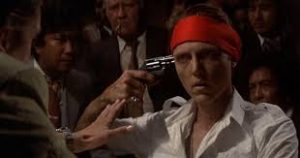
American actor (George) Richard Chamberlain (1934) appeared in Dr Kildare (which even I would struggle to remember), mini-series Shogun in 1980 and The Thorn Birds in 1983. I wonder if he met Japanese actor Dokumamushi Sandayu (1936, and don’t ask me what he’s been in!) while filming Shogun, assuming at least some of it was shot on location. Another American, Christopher Walken, was Ronald Christopher Walken at his birth in 1943, and is perhaps best known for blowing his brains out while playing Russian roulette in the film The Deer Hunter. Don’t try that at home.
Fans of the Partridge Family may recognise the name of actress/singer Shirley Jones, who is eighty-three today. In the musical sitcom, she played David Cassidy’s mother and is in real life his stepmother, having been the second wife of actor/singer/director, the late Jack Cassidy. Cassidy Snr was bipolar (manic depressive), an alcoholic and bisexual – quite a combination. He sadly died aged only forty-nine, when he nodded off on a sofa after a boozy night out and set light to it with a cigarette.

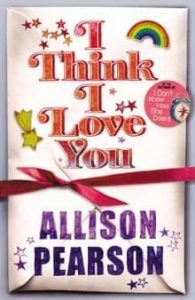
David C has had his own, well-documented trials with alcoholism and more than one trip to rehab. But before that and the more recent shocking revelation that he is suffering from dementia, he spent many years, first as a teen idol and then a popular singer/actor who managed to evolve from child star to adult entertainer. I was never a fan of the young DC, but a friend, author/journo Allison Pearson most certainly was – with bells on. Her second novel, I Think I Love You (I wonder where she got the title from?)  is written in two parts, the first about two young girls, Petra and Sharon, living in 1970s South Wales. Their lives revolve around their shared crush, David Cassidy, and so to a certain extent the story is autobiographical.

The book – I believe the only one ever printed with my (real) name included in the Acknowledgements – was launched in June 2010 and the OH and I toddled along to Cambridge for a lavish party, to join a huge number of people gathered under the marquee to be fed, watered and entertained – I rather doubt I could fill the garden shed. But the road to finished MS was a very rocky one for Allison (and everyone who knew her!) Amongst other things, Miramax threatened to sue over delayed delivery (it was due in 2005, which is impressively late in anyone’s book!) and her agent, Pat Kavanagh, tragically died of a brain tumour. Incidentally, since we’re a bit low in the unusual names department this month, can I just mention that Allison was born Judith Allison Lobbett … Pearson comes from her ex-husband, Simon Pearson.
Right. What else? Anyone interested in knowing that on this day in 1996 actor and director Clinton (aka Clint) Eastwood (then 65) married news anchor Dina Ruiz (30) in Las Vegas – that’s what you call an age gap! The marriage lasted until 2014 – eons by Hollywood standards. Clint was named after his father – imagine the senior version being asked his name, ‘Clint Eastwood.’ ‘Yeah right, very funny buddy – now what’s your real name?’

Nipping forward to 2011, Italian Canadian singer Michael Bublé (my auto-correct keeps insisting that should be Bubble – I do see its point) aged 35, tied the knot with actress and model Luisana Lopilato (23) in Buenos Aires. Not such a happy day one year before though, when Dawson’s Creek actor, James Van Der Beek (32) and actress Heather Ann McComb (33) divorced after almost seven years – an almost-itch. At least we’ve collected a few more contenders for the dodgy name competition – my money is on Ms Lopilato so far. Has a nice ring to it.

Historically on 31st March, in 1657 English Parliament made the Humble Petition to Lord Protector Oliver Cromwell and offered him the crown, which he declined. Gold not his colour, perhaps. Quebec and Montreal were incorporated (1831), and keeping a tenuous French connection, in 1889 the Eiffel Tower – designed by engineer and architect Gustave Eiffel – officially opened in Paris. It was built as a gateway to the Exposition Universelle, and at 300m high retained the record for the tallest man-made structure for 41 years. The tower usurped the Washington Monument for the title and was itself knocked from the perch when the Chrysler Building in New York City was finished in 1930.

In 1903, a dude called Richard Pearse flew a monoplane several hundred yards in Waitohi, New Zealand. The plane resembled a modern-day micro light and witness accounts controversially suggested he flew before the Wright brothers took off into the wide blue yonder – claims which were subsequently discounted. Fast forward eleven years and the bi-planes flown in WWI were not a great deal more substantial than these pioneering aircraft.

My paternal great grandmother, Rose, was born in Kingston upon Thames workhouse in 1876 – as was her mother (also Rose) before her. It’s almost impossible to comprehend the levels of poverty and deprivation they would have endured in those dark, patriarchal days of extreme inequality during the Victorian era. (There is a point here, loosely connecting Richard Pearse and my ancestors – I promise. Bear with me. Or bare with me, if you prefer; I won’t look.) Younger Rose must have been made of pretty stern stuff, because she pulled herself up by the bootstraps and married a wealthy landowner – way da go, Rose! That level of social mobility was almost unheard of then. One of their sons, my grandfather Wilfred, lied about his age to join up as a pilot with the Royal Flying Corps, twenty days before his seventeenth birthday in August 1914. (Got there in the end!)

There are quite a few anecdotes surrounding Wilfred’s flying career – one of my favourites is when he formed the airborne escort for the King of Belgium. Inevitably, they came under attack from German aircraft and once Wilfred had run out of ammo, he soared above the enemy plane and threw his toolbox down on the poor pilot, who – if he didn’t die of heart failure – may have had a bit of a headache thereafter. Apparently, there was no official recognition of his quick-witted act of bravery – not even a new toolbox. My grandmother once told me that when Wilfred asked her out before the war, she turned him down flat because he looked too young. It seems that his service years aged him a little (unsurprisingly!) because they got together immediately upon his return. Lucky for me.

Now it’s time for me to fly (so sorry!) Thanks once again for having me, Jenny – now stop eating those hot cross buns! A moment on the lips …

Toodles.

NP

Author.to/NellPeters

***

Another triumph Nell – thank you so much!!

(As if I’d over eat Hot Cross Buns…hides crumbs quickly…)

Happy reading everyone,

Jenny x 
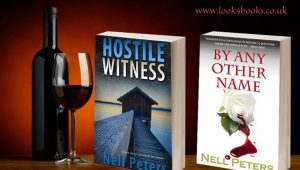
Mother’s Day: Quick Gift Guide

On March 26th Mothering Sunday is celebrated here in the UK.

If you fancy a change from buying your Mum a bunch of flowers, how about treating her to something to read while she puts her feet up and you cook her dinner? (Well, it’s just a thought!!)

Here’s a few quick and easy suggestions to help things along.

COSY COFFEE TIME READS

Another Cup of Coffee

Another Cup of Coffee - New cover 2015

Thirteen years ago Amy Crane ran away from everyone and everything she knew, ending up in an unfamiliar city with no obvious past and no idea of her future. Now, though, that past has just arrived on her doorstep, in the shape of an old
music cassette that Amy hasn’t seen since she was at university.

Digging out her long-neglected Walkman, Amy listens to the lyrics that soundtracked her student days. As long-buried memories are wrenched from the places in her mind where she’s kept them safely locked away for over a decade, Amy is suddenly tired of hiding.

It’s time to confront everything about her life. Time to find all the friends she left behind in England, when her heart got broken and the life she was building for herself got completely shattered. Time to make sense of all the feelings she’s been bottling up for all this time. And most of all, it’s time to discover why Jack has sent her tape back to her now, after all these years…

With her mantra, New life, New job, New home, playing on a continuous loop in her head, Amy gears herself up with yet another a bucked-sized cup of coffee, as she goes forth to lay the ghost of first love to rest…

Amazon UK – http://www.amazon.co.uk/Another-Cup-Coffee-Jenny-Kane/dp/1783751126/ref=sr_1_1?ie=UTF8&qid=1377605533&sr=8-1&keywords=another+cup+of+coffee

Amazon US – http://www.amazon.com/Another-Cup-Coffee-Jenny-Kane/dp/1783751126/ref=sr_1_1?ie=UTF8&qid=1377605667&sr=8-1&keywords=another+cup+of+coffee+jenny+kane

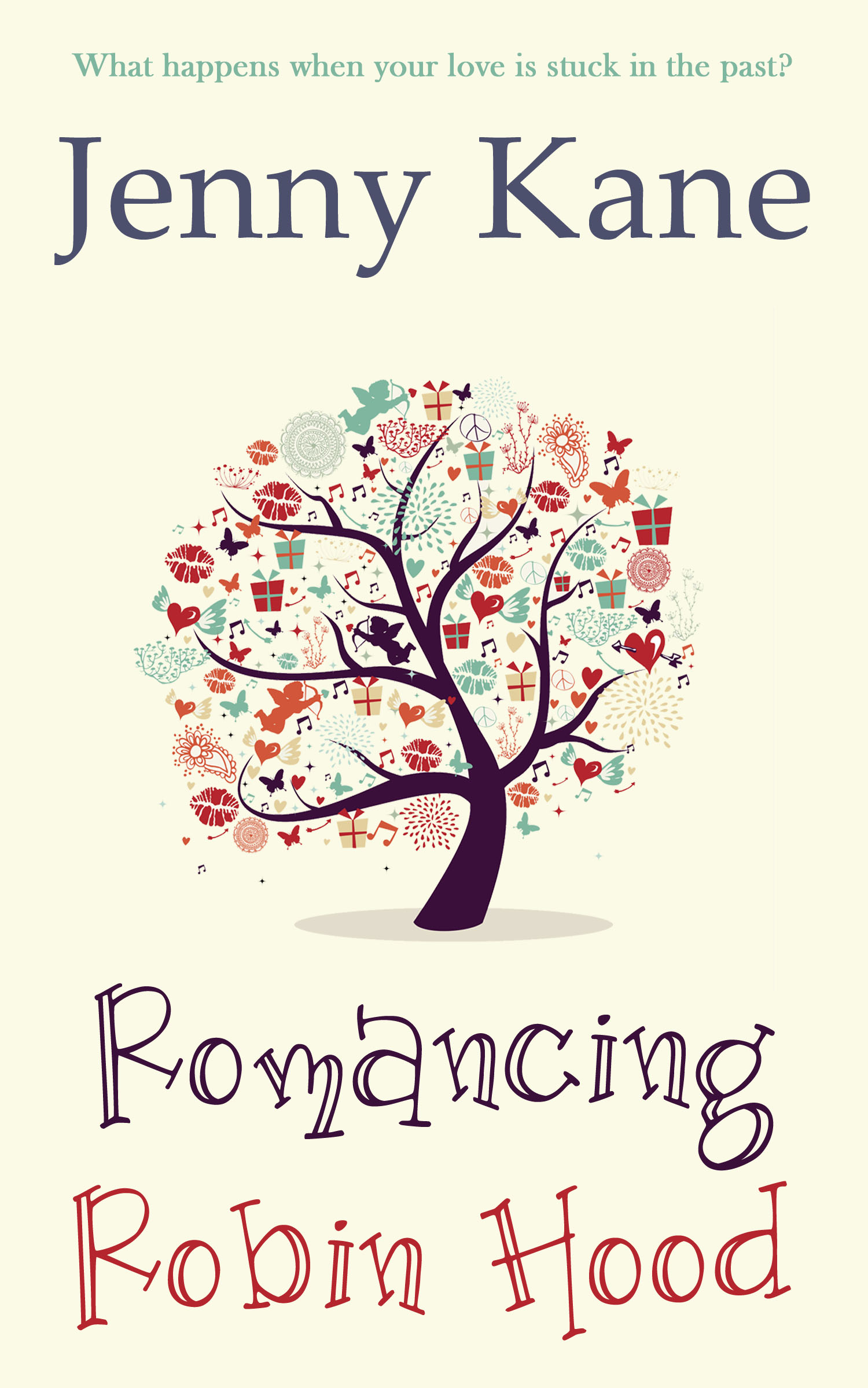
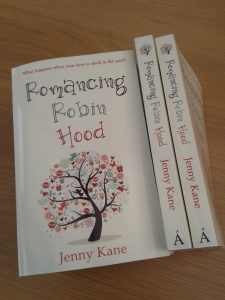
Romancing Robin Hood

 RRH- new 2015

Dr Grace Harper has loved the stories of Robin Hood ever since she first saw them on TV as a girl. Now, with her fortieth birthday just around the corner, she’s a successful academic in Medieval History, with a tenured position at a top university.

But Grace is in a bit of a rut. She’s supposed to be writing a textbook on a real-life medieval gang of high-class criminals – the Folvilles – but she keeps being drawn into the world of the novel she’s secretly writing – a novel which entwines the Folvilles with her long-time love of Robin Hood – and a feisty young girl named Mathilda, who is the key to a medieval mystery…

Meanwhile, Grace’s best friend Daisy – who’s as keen on animals as Grace is on the Merry Men – is unexpectedly getting married, and a reluctant Grace is press-ganged into being her bridesmaid. As Grace sees Daisy’s new-found happiness, she starts to re-evaluate her own life. Is her devotion to a man who may or may not have lived hundreds of years ago really a substitute for a real-life hero of her own? It doesn’t get any easier when she meets Dr Robert Franks – a rival academic who Grace is determined to dislike but finds herself being increasingly drawn to… 

Amazon.com- http://www.amazon.com/Romancing-Robin-Hood-love-story-ebook/dp/B00M4838S2/ref=sr_1_1?ie=UTF8&qid=1409936409&sr=8-1&keywords=romancing+robin+hood

Amazon UK- http://www.amazon.co.uk/Romancing-Robin-Hood-Jenny-Kane-ebook/dp/B00M4838S2/ref=tmm_kin_swatch_0?_encoding=UTF8&qid=1407428558&sr=8-1 

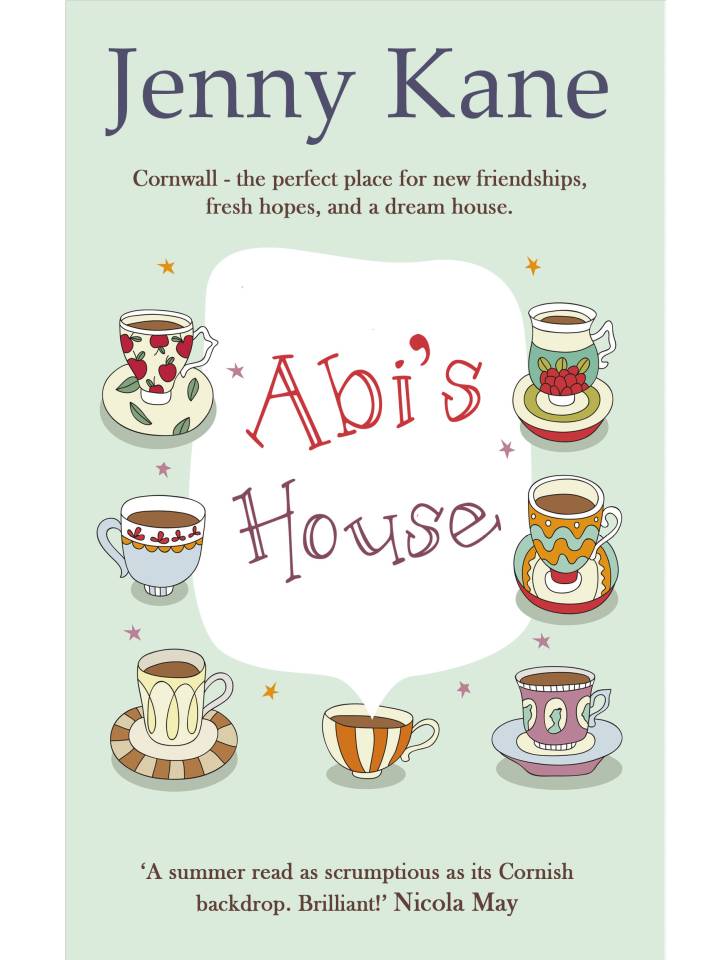
Abi’s House

abis-house-new-cover

Newly widowed and barely thirty, Abi Carter is desperate to escape the Stepford Wives lifestyle that Luke, her late husband, had been so keen for her to live. Abi decides to fulfil a lifelong dream. As a child on holiday in a Cornwall she fell in love with a cottage – the prophetically named Abbey’s House. Now she is going to see if she can find the place again, relive the happy memories …maybe even buy a place of her own nearby? On impulse Abi sets off to Cornwall, where a chance meeting in a village pub brings new friends Beth and Max into her life. Beth, like Abi, has a life-changing decision to make. Max, Beth’s best mate, soon helps Abi track down the house of her dreams …but things aren’t quite that simple. There’s the complicated life Abi left behind, including her late husband’s brother, Simon – a man with more than friendship on his mind … Will Abi’s house remain a dream, or will the bricks and mortar become a reality?

***
HISTORICAL FICTION as Jennifer Ash
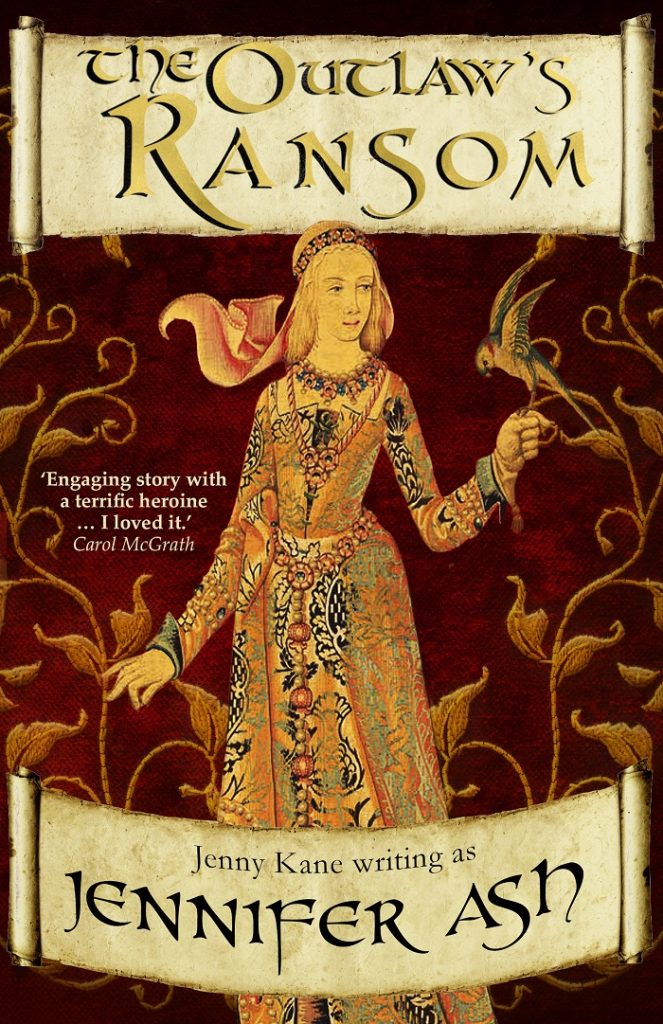
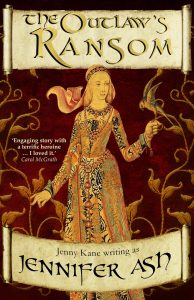
outlaws-ransom-final
A historical novella by Jennifer Ash, set in the lawless English countryside during the 1300s.
When craftsman’s daughter Mathilda falls foul of the infamous Folville brothers, a local family who run the district as their personal kingdom, her life is in danger…but surely not all the stories about the Folvilles are true…are they?
***
I hope that’s given you a few ideas. If you want more, then just check out my Amazon author page – https://www.amazon.co.uk/Jenny-Kane/e/B00HYZIL1E/ref=dp_byline_cont_book_1
Happy last minute gift buying!
Jenny x

How did the Folville family view Robin Hood?

outlaws-ransom-5-star

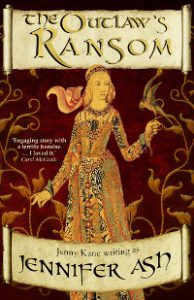
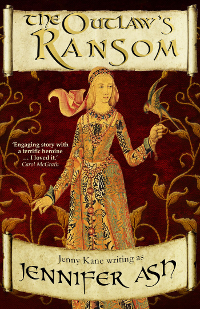
The Outlaw’s Ransom is my very first title under the name of Jennifer Ash.

Blurb

The first in an exciting new series by acclaimed author Jenny Kane writing as Jennifer Ash.

When craftsman’s daughter Mathilda is kidnapped by the notorious Folville brothers, as punishment for her father’s debts, she fears for her life.  Although of noble birth, the Folvilles are infamous throughout the county for disregarding the law – and for using any means necessary to deliver their brand of ‘justice’.

Mathilda must prove her worth to the Folvilles in order to win her freedom. To do so she must go against her instincts and, disguised as the paramour of the enigmatic Robert de Folville, undertake a mission that will take her far from home and put her life in the hands of a dangerous brigand – and that’s just the start of things…

A thrilling tale of medieval mystery and romance – and with a nod to the tales of Robin Hood – The Outlaw’s Ransom is perfect for fans of C.J. Sansom and Jean Plaidy.

The Outlaw's RansomThe Outlaw’s Ransom (which originally saw life as part of my contemporary fiction/medieval mystery timeslip novel, Romancing Robin Hood), is a book that’s very close to my heart.  Anyone who follows this blog will know that it is my love of all things Robin Hood which led to me researching the real life criminal gang, the Folville brothers, and considering how they might have been influenced by the outlaw ballads that would have been circulating at the time.

It was interesting to be able to give, what I imagine, the Folville family’s perspective on the Robin Hood stories might be.

rh-and-the-monk

Extract

…Eustace de Folville continued, ‘You know something of us, Mathilda, from living in these parts. And, I have no doubt, my dear brother has explained to you our beliefs on maintaining our lands and beyond, keeping a weather eye on the dealings of all men in this hundred.’

Mathilda bit her tongue in an effort to remain demurely mute, trying to concentrate on what Eustace was saying and not on the unknown fate of her younger brother.

‘He has also, I believe, told you of his fascination with stories,’ Eustace gave Robert a blunt stare; leaving Mathilda to wonder whether it was his brother’s passion for the minstrels’ tales, or the fact he’d shared that belief and interest with a mere chattel, that Eustace disapproved of.

‘The balladeers have become obsessed of late with the injustices of this land. Often rightly so. Naturally the fabled Robyn Hode has become a hero. An ordinary man who breaks the law, and yet somehow remains good and faithful in the eyes of the Church, is bound to be favoured. In years past such a character’s popularity would have been unthinkable, but these days, well …’

Eustace began to pace in front of the fire, reminding Mathilda of how his brother had moved earlier, ‘Now we are empowered by the young King, the Earl of Huntingdon, and Sheriff Ingram, to keep these lands safe and well run, and by God and Our Lady we’ll do it, even if we have to sweep some capricious damned souls to an earlier hell than they were expecting along the way.’

Eustace was shouting now, but not at her. His voice had adopted a hectoring passion, and Mathilda resolved that she would never willingly disappoint this man; it would be too dangerous.

‘Many of the complaints of crimes and infringements that reach my family’s ears are not accurate. Far more felonies are alleged out of spite or personal grievance than are ever actually committed. We require more eyes and ears, girl. Accurate, unbiased eyes and ears.

‘The sheriff of this county is not a bad man. No worse than the rest anyway; but Ingram is sorely stretched. He has not only this shire, but Nottinghamshire and Derbyshire within his writ. The man cannot be everywhere at once. No man can.

‘We are believed to have a band of criminals under our control, Mathilda. This is not true. I’m no Hode, although I am lucky to have the respect of the immediate population, and although I know that respect is because they go in fear of me, I’d rather have that than no respect at all. Hode’s principles I embrace, as I do other outlaw heroes’ who have flouted a law more corrupt than they are. Those such as Gamelyn can give a man a good example to follow. What was it he declared, Robert, to the Justice at his false trial?’

Moving into the light of the table, Robert thought for a second before reeling off a verse he’d probably known by heart since childhood, ‘Come from the seat of justice: all too oft Hast thou polluted law’s clear stream with wrong; Too oft hast taken reward against the poor; Too oft hast lent thine aid to villainy, And given judgment ’gainst the innocent. Come down and meet thine own meed at the bar, While I, in thy place, give more rightful doom And see that justice dwells in law for once.’

Eustace nodded to his brother, who’d already shrunk back into the shadows of the nearest wall, ‘I do not have such a band at my beck and call, Mathilda. When I need help I have to pay for it.’

***

The values that – in my mind at least- the Folville brothers see in the stories of Robin Hood form an important undying theme to this tale- and to Mathilda of Twyford they will make the difference between life and death…

lytell-geste

If you’d like to read my first medieval mystery, then The Outlaw’s Ransom is available for your Kindle here –

https://www.amazon.co.uk/Outlaws-Ransom-Jennifer-Ash-ebook/dp/B01LZDKPQM/ref=sr_1_1?s=digital-text&ie=UTF8&qid=1475660907&sr=1-1&keywords=The+Outlaw%27s+Ransom+Jennifer+Ash

https://www.amazon.com/Outlaws-Ransom-Jennifer-Ash-ebook/dp/B01LZDKPQM/ref=sr_1_1?ie=UTF8&qid=1475660990&sr=8-1&keywords=The+Outlaw%27s+Ransom+Jennifer+Ash

Happy reading everyone,

Jennifer (aka Jenny!!) xx


Who the hell are you?

Hello, it’s Jenny Kane here – or is it?

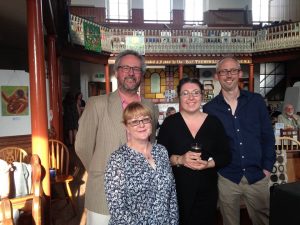
Last week I was lucky enough to go to the Exeter Writer and Blogger Meet Up, organised by the lovely Kim Nash and Holly Martin. It was a relaxed affair, with the only request made of us being that we wore name badges. I decided, in the interests of simplicity, just to use two of my many names- more for my sanity than anything else!

It was so busy – really wonderful! However, I had an attack of shy syndrome, and so I sat and chatted to many of the folk I’d met before- despite telling myself I must be brave and mingle!

This situation was not destined to remain however…

The pub in which was all met was open to the public as well as to us writer types. Unbeknown to me (as I had my back to the bar and am as deaf as a post), a stag party had come in. There they were, all dressed as characters from Top Gun, merrily ( I use the word advisedly) chatting to some of my fellow writers. Then, suddenly, there was a tap on my shoulder, and the words, ‘Hey, you’re the porn woman’ were being hurtled towards me at high speed…

Cue some good natured banter with said stag party.

Letting my inner Kay Jaybee take over, I coaxed the lads outside, where I took lots of photos for them – of them I hasten to add- and was about to make my way off when one of them produced a Sharpie…A little clothing signing later and I bid them a fond farewell and returned to the writer throng.

It was at that moment when a lady – who I regretfully didn’t catch the name of- turned to me and uttered the immortal words ‘Who the hell are you?!’

And so…maybe it’s time for a recap…

Jenny Kane writes RomCom style contemporary fiction – with a hint of romance and a healthy spattering of coffee drinking included. (Tea drinkers are also welcome)

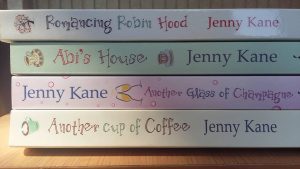
book-pile

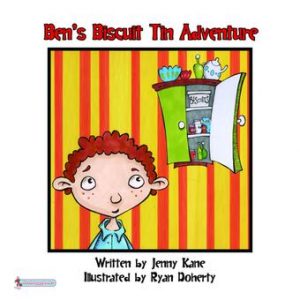
Jenny Kane also writes children’s picture books of the very quirky variety. There is no coffee on offer, but cookies are involved by way of compensation.

title-page

Jennifer Ash writes fourteenth century medieval mysteries– also with a hint of romance, but with no coffee whatsoever. There is ale though – lots of ale.

The Outlaw's Ransom

Kay Jaybee writes award winning, full on, adult only, erotica (not porn, despite the claims of the aforementioned stag party). It has been known to include coffee… Enough said… If you wish to learn about Kay, then feel free to visit her at www.kayjaybee.me.uk You should NOT visit Kay unless you are over 18. If you are under 18 and you visit her, you’ll make her very cross- not something I’d advise you doing…

best-of-kjb

There is another ‘ME’, but that name is not shared…ever…

And then of course, there is me. The actual me, who looks remarkably like Jenny and Jennifer and Kay. I can’t tell you that much about her except she works 12-14 hour shifts as a writer every day, and goes to work, and runs a house, and has a family (pretty much like every other writer I know). She often has moments of total forgetfulness, is very clumsy, drinks WAY too much coffee, loves Malteasers, and is rather keen on all things Robin Hood…Oh, and she is generally a very happy person.

Hope that’s helped a bit.

After the stag do incident I became much braver, and I spoke to some wonderful people in Exeter- although not as many as I’d have liked to as time ran out on me. Maybe next time.

Happy reading everyone,

Jenny/Jennifer/Kay/Me xxx

crazy


The Importance of Instant Impact

There are many rules in the construction of good story. One of the most important is instant impact- the art of capturing the attention of your readers/potential readers as quickly as possible.

Take your lead from the balladeers and the storytellers of history. If they didn’t impress the audience who gathered to hear their tales by the end of the second line they’d uttered, then they wouldn’t earn enough money to eat that night.

For the modern writer this lesson is a good one. There are so many books in the world that, if you don’t take a firm grip of your reader’s imagination within the first two or three paragraphs (if not sentences), then the chances of you selling your work is automatically harder. If not impossible. Editors and agents read hundreds of first paragraphs each month. If you don’t engage them straight away they won’t read more than a few pages. Consequently, every single word you have written after page four is in danger of being nothing but a waste of time.

Here are a few ways to create instant impact to grab that elusive audience- and hopefully keep them grabbed!

–          Start with some powerful first line dialogue. Something that makes you want to know what follows, and why what is being said, is being said. Such as…

“Last night I dreamt I went to Manderley again.” – (Rebecca, Daphne du Maurier)

–          Add immediate tension by starting in the thick of the action. Such as…

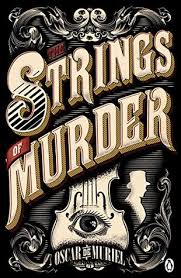
Dr Clouston could barely keep himself on the seat. The wheels of his carriage kept cracking over humps and puddles, breaking the night’s silence as they rode frantically towards Dundee.  –  (The Strings Murder, Oscar de Muriel)

–          Build a scene on paper that draws the reader in so much, that they want to be there- or that leaves them feeling relieved that they aren’t.  Such as…

“It was the best of times, it was the worst of times, it was the age of wisdom, it was the age of foolishness, it was the epoch of belief, it was the epoch of incredulity, it was the season of Light, it was the season of Darkness, it was the spring of hope, it was the winter of despair, we had everything before us, we had nothing before us, we were all going direct to Heaven, we were all going direct the other way.” – (A Tale of Two Cities, Charles Dickens)

–          Start with a sentence that makes sense- but makes the reader need to keep going to find out what on earth is going on. Such as…

“It was a bright cold day in April, and the clocks were striking thirteen.” – (1984, George Orwell)

–          Begin with a recollection. A situation that your novel will later explain. Such as…

“Many years later, as he faced the firing squad, Colonel Aureliano Buendía was to remember that distant afternoon when his father took him to discover ice.” – (One Hundred Years of Solitude, Gabriel García Márquez)

In an age of instant technology and an immediate availability of information, people are used to instant gratification- so the faster you engage your readers mind, the better!

Happy writing,

Jenny x


Goodbye February: Nell Peters’ end of month round up

Where did February go? Have you got it? I could have sworn we were only halfway through the month…

Still… the plus side of the days dashing by is that it’s time for Nell Peters to pop along with her end of month round up. It’s another cracker…

Hello! Let’s start with a straw poll – hands up all those being sued by their postman, for back/shoulder injuries sustained while delivering your many sacks full of Valentine cards … Nope, me neither.

The end of February means we can take a short breather from family (ergo horribly expensive) birthdays – ten between 24/12 and 20/2. TEN! So far this year we have had two first birthdays, two ninetieths and one fortieth amongst the more run of the mill anniversaries, including two daughters-in-law who were both born on 11th January.

What are the chances? I don’t know, but it should most definitely not be allowed! During March, there are just two card-only relative birthdays, in April three close family celebrations – all lulling us into a false sense of security before May hits the bank balance right between the eyes once more. Two sons, a grandson and a niece all chose to turn up during the ‘merry’ month (although not so merry for us!), plus a whole array of other family and friends. Please remember to send food parcels and wine at that time.

A bit of a grasshopper post this month, going boing, boing, boing all over the place – so listen carefully, I will say this only once. Speaking of which, about a hundred years ago, I used to know Stuart H-C, brother of the actress (Kirsten H-C) who played that part in Allo, Allo – I wonder what he’s doing now … probably not being a grasshopper, or even going boing. He never did strike me as much of a boinger.

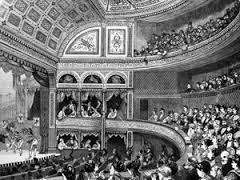
28th February has been a musical day over the centuries: in1728 George Frideric Handel‘s opera, Siroe, re di Persia (Siroe, King of Persia – now Iran) premiered in London, followed ninety-one years later by the first performance in Vienna of Franz Schubert‘s song, Schäfers Klageleid (Shepherd Song Suit – perhaps something gets lost in Google translation? Suite I could understand, but suit?) Poor old Franz was only thirty-one when he died (I’ve got jeans older than that!), by which time he had composed more than six hundred pieces; that’s an awful lot of bum notes and treble clefs. Also in Vienna, in 1828, Franz Grillparzer’s Ein Treuer Diener (A Faithful Servant) was first performed, but in1862 Charles Gounod bucked the trend and chose gay (can you still say that?) Paris to unleash his Grand Opera La Reine de Saba (The Queen of Sheba) upon the world. Slipping ever so slightly downmarket, the first American vaudeville theatre opened in Boston, Massachusetts in 1883.

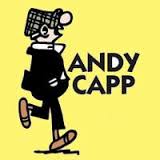
Sticking to a musical theme for a moment, now your toes are tapping and you are discreetly la-la-ing, an awful lot of composers have been born on 28th February – step forward and take a bow Kaspar Förster (1616); Justin Morgan (1747); Juliusz Zarebski (1854); Gustave Adolph Kerker (1857); Viliam Figus (1875); John Alden Carpenter (1876); Sergei Bortkiewicz (1877); Artur Kapp (1878); Richard Heinrich Stein (1882); Roman Maciejewski (1910); Vladimir Sommer (1921); and sharing a date of birth, we have Seymour Shifrin and Stanley Glasser in 1926. Charles Bernstein rocked up in 1943, Stephen Chatman in 1950, with William Finn spoiling his poor mother’s day two years later, and Junya Nakano bringing up the rear in 1971. A cast of thousands – and a few strong candidates for this month’s weirdo name competition. I wonder if Artur Kapp has any remote connection to Andy Capp? I’m thinking anglicised name … no, perhaps not. Forget I spoke.

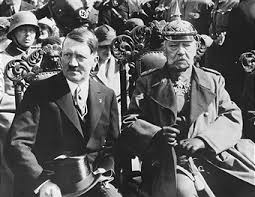
On the world stage, this day in 1933 Adolf Hitler banned the German Communist Party (KPD), and not to be outdone, German President Paul von Hindenburg abolished free expression of opinion (except his own, I expect) – the slippery slope to dictatorship and WWII. But two years before war was declared, came the Hindenburg Disaster – the airship LZ (Led Zeppelin; not the rock band) 129, which was presumably named after the president who had died in 1934 while still in office, came a right royal cropper. I don’t know about you, but the thought of trusting my luck to an inflated pillow case with an engine attached doesn’t appeal too much.

The Hindenburg left Frankfurt on the evening of May 3, 1937, on the first of ten round trips between Europe and the US scheduled for its second year of commercial service – American Airlines had contracted the operators to shuttle passengers from Naval Air Station Lakehurst to Newark for connections with conventional air flights. Except for strong headwinds massively slowing progress, the Atlantic crossing was unremarkable, until the Hindenburg attempted an early-evening landing at Lakehurst on May 6. Although carrying only half its full capacity of passengers (thirty-six of seventy) and sixty-one crew of which twenty-one were trainees on the outward flight, the return flight was fully booked. Many of the passengers with tickets to Germany were planning to attend the coronation of King George VI and Queen Elizabeth in London the following week – choosing to travel in comfort and style, much like an ocean liner only quicker.

As the pilot tried to dock, the Hindenburg caught fire and quickly became engulfed in flames. It had a cotton skin covered with a finish known as ‘dope’ – no, not the recreational drug or idiot person, but a plasticised lacquer that provides stiffness, protection, and a lightweight, airtight seal to woven fabrics. In its liquid forms, dope is highly flammable, but the flammability of dry dope depends upon its base constituents. One hypothesis for the cause of the accident was that when the mooring line touched the ground, a resulting spark could have ignited the dope in the skin – goodnight Vienna (which is getting a pretty good airing in this blog). Other theories favoured sabotage, even naming the crew member they held responsible, but since he’d died in the fire, the poor chap couldn’t defend himself.

Best of all, it was suggested that Adolf Hitler ordered the Hindenburg to be destroyed in retaliation for Hugo Eckener’s (former head of the Zeppelin company) anti-Nazi opinions. Whatever the cause, thirteen passengers and twenty-two air crew died, plus one ground crewman – but if you see the speed with which the craft burned, it’s nothing short of a miracle that anyone walked away.

Let’s cheer up! On this day in 2016, the 88th Academy Awards ceremony (aka the Oscars) was held at the Dolby Theatre in Hollywood, Los Angeles – not being much of a cinema goer, I haven’t seen any of the films nominated. My only real interest, to be honest, is to gawp at the posh frocks; not too much Primani on show as a rule, but then if you know 34.42 million people in the US alone are going to be tuned in, casting a very critical eye over your choice of clobber, you’d make a bit of an effort, I guess. Even so, some make amazing fashion faux pas in their effort to be noticed. In the unlikely event that I ever get an invitation, I think I’ll play it safe with my usual Tesco super-skinny jeans and some grotty top – to make my entrance incognito as one of the cleaners, so I don’t have to have my photo taken.

Just in case you were wondering, Spotlight won two awards, including Best Picture, and Mad Max: Fury Road won six, the biggest haul of the evening. The Revenant earned three, including Best Director for Alejandro G. Iñárritu and Best Actor for Leonardo DiCaprio. Brie Larson won Best Actress for Room, and Mark Rylance and Alicia Vikander won supporting actor Oscars for Bridge of Spies and The Danish Girl, respectively. And the Oscar for the most difficult to pronounce name goes to …

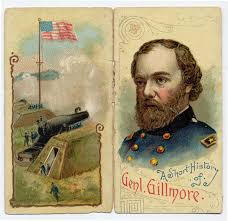
Major General Quincy Adams Gillmore was born on this day in 1825 in Black River (now Lorain County), Ohio – that’s unless you believe Wikipedia, which gives his dob as 25th Feb. But who believes Wiki-p? Call me suspicious, but I think he was named after the 6th President of the US, John Quincy Adams, who was voted in by the House of Representatives earlier in February. 1825 was the same year that the idea to store food in tin cans was patented; the first detachable shirt collar was created; the first hotel in Hawaii was opened (I wonder if it was a Travelodge?); Charles X became King of France and the Stockton to Darlington railway line was opened.

The Maj Gen must have been something of a Smarty Pants because he graduated top of his class at the US Military Academy at West Point in 1849, and received a commission in the Corps of Engineers. He helped build forts until 1852, taught at West Point from 1852 to 1856, and was the head of the Engineer Agency in New York City from 1856 to 1861, when the American Civil War began. He was noted for his actions in the Union Army victory at Fort Pulaski, where his modern rifled artillery pounded the fort’s exterior stone walls – an action that essentially rendered stone fortifications obsolete – and he earned an international reputation as an organizer of siege operations, helping to revolutionize the use of naval gunnery. Not much of a pacifist, then.

Four racing drivers born on this day are Belgian Eric Bachelart (1961), Brazilian Ingo Hoffmann (1953), and Italian-America terrible twins Mario Andretti and his much lesser-known brother Aldo (1940), who gave up his fledgling career after a serious accident in 1959. Rising from a background of extreme poverty in Europe and moving to the States when very young, the boys really lived the American Dream – as well as every schoolboy’s dream of driving a racing car. Speeding like a lunatic must either have been learned behaviour or in the genes, because both Mario’s son, Michael and grandson Marco, also became racing drivers.

Who remembers mention of Stuart H-C at the beginning of this twaddle-fest? OK, you get a prize. His dad, Miles (known as Bill) was a test driver/mechanic on the team of racing driver Tommy Sopwith, whose own father – also Thomas – was the aviation pioneer who built the Sopwith Camel aircraft in 1916/17. (My paternal grandfather probably flew one as a pilot in the Royal Flying Corps during WWI.) Ironically, Miles H-C was tragically killed in a road traffic accident when his children were very young, and they grew up not really remembering him. But at least he was driving an E Type Jaguar when he crashed, as Kirsten once said.

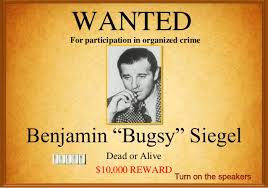
Unlike the aforementioned Andretti brothers, Benjamin Siegel (nickname Bugsy, ergo a definite contender for the weirdo name contest) – born in Brooklyn on this day in 1906 – wasn’t so keen on doing an honest day’s work to get ahead. A gangster with the Luciano crime family, he was one of the most infamous and feared gangsters of his day and a driving force behind the development of the Las Vegas Strip in Nevada. Nowadays, the tacky area is packed with casinos and hotels – fourteen of the world’s twenty-five largest hotels (by room count) are on the Strip, with a total of over 62,000 rooms. That’s a lot of beds to make.

Bugsy’s career met a premature end in June 1947, when he had an argument with a bullet and the bullet won – those who live by the sword … And on that point (snigger) I’m gone – thanks again for having me, Jenny!

Toodles

NP

Author.to/NellPeters

***

Always welcome hun – another wonderful blog! Thank you xx

Romancing it medieval style

Romancing Robin Hood is a contemporary romance all about history lecturer Dr Grace Harper- a woman nuts about Robin Hood (especially the 1980’s television show, Robin of Sherwood).

Not only does Romancing Robin Hood tell the story of Grace’s fight to find time for love in her own busy work filled life, it also contains a secondary story – a medieval mystery that Grace is writing.

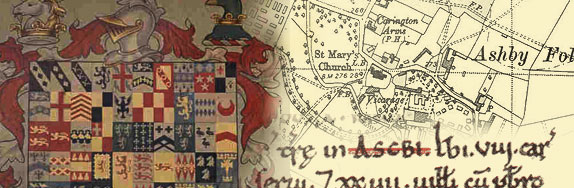
history-of-ashby-folville

In the story Grace is writing, her fourteenth century protagonist, Mathilda, is getting to know the real life outlaw family- the Folville’s- rather better than she would have liked. As well as living with them, Mathilda suddenly finds herself under a very frightening type of suspicion.

RRH- new 2015

Here’s an extract from Mathilda’s story as Grace sits and writes it…

Mathilda thought she was used to darkness, but the dim candlelight of the comfortable small room she shared at home with her brothers was nothing like this. The sheer density of this darkness seemed to envelop her, physically gliding over Mathilda’s clammy goose-pimpled skin. This was an extreme blackness that coated her, making her breathless, as if it was stealthfully compressing her lungs and squeezing the life from her.

Unable to see the floor, Mathilda presumed, as she pressed her naked foot against it and damp oozed between her toes, that the suspiciously soft surface she was sat on was moss, which in a room neglected for years had been allowed it to form a cushion on the stone floor. It was a theory backed up by the smell of mould and general filthiness which hung in the air.

Trying not to think about how long she was going to be left in this windowless cell, Mathilda stretched out her arms and bravely felt for the extent of the walls, hoping she wasn’t about to touch something other than cold stone. The child’s voice that lingered at the back of her mind, even though she was a woman of nineteen, was telling her – screaming at her – that there might be bodies in here, still clapped in irons, abandoned and rotting. Mathilda battled the voice down; knowing it that would do her no good at all. Her father had always congratulated Mathilda on her level headedness, and now it was being put to the test. She was determined not to let him down now.

Placing the very tips of her fingers against the wall behind her, she felt her way around. It was wet. Trickles of water had found a way in from somewhere, giving the walls the same slimy covering as the floor. Mathilda traced the outline of the rough stone wall, keeping her feet exactly where they were. In seconds her fingers came to a corner, and twisting at the waist, she managed to plot her prison from one side of the heavy wooden door to the other, without doing more than extending the span of her arms.

Mathilda decided the room could be no more than five feet square, although it must be about six foot tall. Her own five-foot frame had stumbled down a step when she’d been pushed into the cell, and her head was at least a foot clear of the ceiling. The bleak eerie silence was eating away at her determination to be brave, and the cold brought her suppressed fear to the fore. Suddenly the shivering Mathilda had stoically ignored overtook her, and there was nothing she could do but let it invade her small slim body.

Wrapping her thin arms around her chest, she pulled up her hood, hugged her grey woollen surcoat tighter about her shoulders, and sent an unspoken prayer of thanks up to Our Lady for the fact that her legs were covered.

She’d been helping her two brothers, Matthew and Oswin, to catch fish in the deeper water beyond the second of Twyford’s fords when the men had come. Mathilda had been wearing an old pair of Matthew’s hose, although no stockings or shoes. She thought of her warm footwear, discarded earlier with such merry abandon. A forgotten, neglected pile on the river bank; thrown haphazardly beneath a tree in her eagerness to get them off and join the boys in their work. It was one of the only tasks their father gave them that could have been considered fun.

Mathilda closed her eyes, angry as the tears she’d forbidden herself to shed defied her stubborn will and came anyway. With them came weariness. It consumed her, forcing her to sink onto the rotten floor. Water dripped into her long, lank red hair. The tussle of capture had loosened its neatly woven plait, and now it hung awkwardly, half in and half out of its bindings, like a badly strapped sheaf of strawberry corn.

She tried not to start blaming her father, but it was difficult not to. Why hadn’t he told her he’d borrowed money from the Folvilles? It was an insane thing to do. Only the most desperate … Mathilda stopped her thoughts in their tracks. They were disloyal and pointless…

…Does Mathilda seem miserable and scared enough? Grace wasn’t sure she’d laid the horror of the situation on thick enough. On the other hand, she didn’t want to drown her potential readers in suffering-related adjectives.

No, on reflection it was fine; certainly good enough to leave and come back to on the next read through. She glanced at the clock at the corner of the computer screen. How the hell had it got to eight thirty already? Grace’s stomach rumbled, making her think of poor Mathilda in her solitary prison.

Switching off her computer, Grace crammed all her notes into her bag so she could read over them at home, and headed out of her office. Walking down the Queen’s Road, which led from the university to her small home in Leicester’s Clarendon Park region, Grace decided it was way too hot, even at this time of the evening, to stand in the kitchen and attempt, and probably fail, to cook something edible, so she’d grab a takeaway.

Grateful it wasn’t term time, so she didn’t have to endure the banter of the students who were also waiting for associated plastic boxes of Chinese food, Grace speedily walked home, and without bothering to transfer her chicken chow mein to another dish, grabbed a fork, kicked off her shoes, and settled herself down with her manuscript…

***

Romancing Robin Hood – Blurb.

Dr Grace Harper has loved the stories of Robin Hood ever since she first saw them on TV as a girl. Now, with her fortieth birthday just around the corner, she’s a successful academic in Medieval History, with a tenured position at a top university.

But Grace is in a bit of a rut. She’s supposed to be writing a textbook on a real-life medieval gang of high-class criminals – the Folvilles – but she keeps being drawn into the world of the novel she’s secretly writing – a novel which entwines the Folvilles with her long-time love of Robin Hood – and a feisty young girl named Mathilda, who is the key to a medieval mystery…

Meanwhile, Grace’s best friend Daisy – who’s as keen on animals as Grace is on the Merry Men – is unexpectedly getting married, and a reluctant Grace is press-ganged into being her bridesmaid. As Grace sees Daisy’s new-found happiness, she starts to re-evaluate her own life. Is her devotion to a man who may or may not have lived hundreds of years ago really a substitute for a real-life hero of her own? It doesn’t get any easier when she meets Dr Robert Franks – a rival academic who Grace is determined to dislike but finds herself being increasingly drawn to…

***

Buy Links

Available in e-format and paperback.

Amazon UK- http://www.amazon.co.uk/Romancing-Robin-Hood-Jenny-Kane-ebook/dp/B00M4838S2/ref=sr_1_1?ie=UTF8&qid=1407428558&sr=8-1&keywords=romancing+robin+hood

Amazon.com- http://www.amazon.co.uk/Romancing-Robin-Hood-Jenny-Kane-ebook/dp/B00M4838S2/ref=sr_1_1?ie=UTF8&qid=1407428558&sr=8-1&keywords=romancing+robin+hood

Kobo link – http://store.kobobooks.com/en-US/ebook/romancing-robin-hood

Nook link- http://www.barnesandnoble.com/w/romancing-robin-hood-jenny-kane/1121088562?ean=9781783754267

***

Since I wrote this medieval sub plot to the main romance of the modern part of Romancing Robin Hood, I have rewritten it, expanded it, and re-released it as a separate novella – The Outlaws’ Ransom. This means you have a choice of how to read the story of Mathilda of Twyford.

You can buy The Outlaw’s Ransom here- http://amzn.to/2dr5ZPo

Happy reading everyone!

Jenny Kane xx

Kate Griffin talks Kitty Peck!

Forgive me a small fan girl moment.

I can’t quite believe I have Kate Griffin on my blog today. Her Kitty Peck series is just brilliant. Not a single word is wasted throughout. I can’t even begin to tell you how much I wish I’d written these books myself!

And what’s more, having had the pleasure of meeting Kate at the Tiverton Literary Festival last year, I can tell you she is a lovely person as well- with great taste in Thai food.

Why not grab a cuppa- possibly with cake- put your feet up for a few minutes, and have a read.

Over to you Kate…

First a big thank you to Jenny for inviting me to contribute and also a huge thank for responding to my Kitty Peck books so enthusiastically. As she also delves into the shady corners of history, her appreciation means a great deal!

Writing a novel is a bit like mountaineering. Admittedly, climbing Mount Everest is a lot more dangerous than sitting in your pyjamas and eating Hobnobs while tapping away at a laptop, but  bear with me because there are definite parallels.

When the going’s good you manage to cover a vast distance in a surprisingly short space of time but on a rough day it doesn’t matter how long you slog away – head down against the wind, digging your crampons into the crumbling ice underfoot – nothing comes right.

Hours can pass and then when you finally look up, snow-blind from the glaring whiteness of the empty screen in front of you, it’s soul-destroying to find that you’ve hardly gone anywhere at all.

Even your ‘footsteps’ – those few feeble paragraphs you managed to hack out – have probably been deleted as you became increasingly dejected, disoriented and unsure which way to go.

It’s as if snow has fallen on your tracks, obliterating every trace of your progress.

Whiteout.

On grim days like this a mountaineer stops, pitches camp, brews up something hot and strong and takes cover until the blizzard has passed.

In writing terms, ‘pitching camp’ means admitting temporary defeat. When nothing comes together, it’s best to switch off your computer (or close your notebook if you’re a long-hander) and do something else, preferably something that makes you happy.

A break usually clears the head and clears the way.

But even then, once you’ve gathered your strength, consulted your charts and stepped boldly back on the trail, the way to the summit can still be treacherous and deceptive.

Sometimes you’re so busy concentrating on reaching those far glittering peaks that you don’t notice the bottomless crevasse yawning in front of you. By this I mean the gaping hole in the plot that you never realised was there until you tried to marshal your characters across the final glacier and en-route to the sunlit upland ending of your story.

One minute it was all going so well; the next you have no alternative but to find another route to your neatly planned conclusion.

Sometimes it can take days to retrace your steps to chart a new way forward or around the chasm. In particularly hazardous conditions you might even have to go right back to the beginning, re-stock your supplies and start out again.

More fortunately, just occasionally when you find yourself teetering on the brink of a deep dark void, inspiration strikes and you find exactly the right piece of equipment in your rucksack to enable you to perform a miraculous leap to safety.

By ‘equipment’ I mean your plot or your characters. It’s amazing how helpful and inventive they can be when you put your mind to it!

Then again, your characters can also be difficult, dangerous travelling companions, particularly the pesky independent ones who refuse to listen to your strict instructions and insist on going off by themselves, getting totally lost in the craggy, uncharted landscape – ie, the parts of your story that you never had any intention of writing. All it takes is to allow a character to wander a few steps off the track you’ve planned and that’s it. They can be missing for days!

By the time you realise what they’ve gone and done, it usually takes a major search party (aka a complete re-write) to locate them and bring them back to the trail.

At testing times like these many writers would be thrilled to see a St Bernard lolloping to the rescue with a giant barrel of brandy hanging round its neck. (Or, in my case, gin).

Now, I’m horribly aware that I’ve pushed my mountaineering metaphor to the limit of human endurance, but there’s one last comparison I’d like to make, and for me it’s very relevant.

Kate Griffin with Michael Jecks, Ruth Ware & Chris Ewan at Tiverton Lit Festival

This week, I’m about to embark on the fourth instalment of my Kitty Peck mystery series, published by Faber and Faber.

Kitty’s world is a version of London in the early 1880s. The setting will be familiar to anyone who loves Conan Doyle’s wonderful Sherlock Holmes stories. Kitty’s London, specifically Limehouse, is a place where menace lurks in the swirling mist rising from the Thames and where the rumble of a hackney carriage generally bodes ill. Kitty is the youthful proprietress of three tawdry music halls, but she is also more, much more.

By the end of the year I hope that Kitty and I will have gone on one last journey together.  At the moment, we’re both at base camp. Around 400 snow-blank pages lie ahead and I have to find a way to guide us across that vast and virgin expanse.

I know exactly where we’re going. If I shield my eyes and squint into the far distance I can see the sparkling summit – our final destination.

I’ve spent the last few months planning and researching. I’ve worked out the route and packed essentials for the journey (well, Hobnobs and gin) but, as I explained above, you can never be quite sure what might crop up on the way.

Now as I stare at all that whiteness ahead, I have to admit that I’m excited… and slightly terrified.


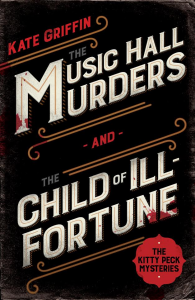
If you’d like to catch up, the first two books in the Kitty Peck series have just been released as a single ebook:

https://www.amazon.co.uk/Kitty-Peck-Mysteries-Murders-Ill-Fortune-ebook/dp/B01M8G7QL2

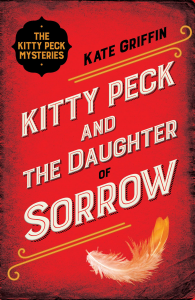
The third book in the series, Kitty Peck and the Daughter of Sorrow, will be published in summer this year:

https://www.amazon.co.uk/Kitty-Peck-Daughter-Sorrow/dp/0571315208

***

What a wonderful blog. Like many writers, I totally equate with the feelings of terror you have described! However, having read the Kitty Peck books to date, I can tell you, you have nothing to worry about!

Happy reading everyone,

Jenny x


Robin Hood: A Very Mini Medieval and Tudor Ballad History

I admit it- I had a lot of fun writing my novel, Romancing Robin Hood and my novella The Outlaw’s Ransom. Each project gave me the chance to take a self indulgent trip down memory lane, and dig out all my PhD notes on the ballad history behind the Robin Hood legend. Although Romancing Robin Hood is a modern contemporary romance, it also contains a second story- a medieval mystery which has more than a hint of the Robin Hood’s about it.

The earliest balladeers sang tales of Robin Hood long before they were written down, and audiences through history have all had different ideas of what Robin Hood was like in word, action, and appearance. Every writer, film maker, and poet ever since the first tales were spoken, has adapted the outlaw figure to fit their own imagination.

Lytell Geste

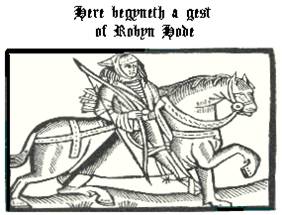
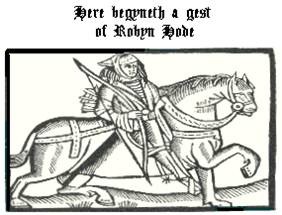
The Lytell Geste of Robyn Hode


The earliest mention found (to date), of the name Robin Hood appears in the poem The Vision of Piers Plowman, which was written by William Langland in c.1377.

A long ballad, Piers Plowman was a protest against the harsh conditions endured by the poor in the Fourteen Century. Not only did it mention Robin Hood, but makes reference to he outlaw gang, the Folvilles, who research suggests were an influence on those whose exploits wrote the Robin Hood ballads.


“And some ryde and to recovere that unrightfully was wonne:

He wised hem wynne it ayein wightnesses of handes,

And fecchen it from false men with Folvyles lawes.”

The Folville family were incredibly dangerous, influential, and had great impact on the Midlands of the UK in the Fourteenth Century. I’ll be introducing this family of brothers to you properly very soon; for they are something of an obsession for historian Dr Grace Harper- the lead character in Romancing Robin Hood.

RH and the monk

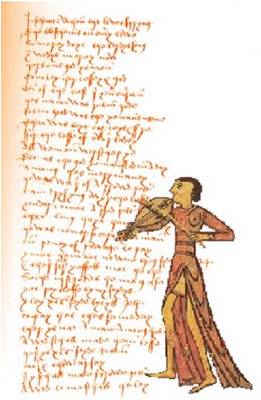
Robin Hood and the Monk


In 1450 the earliest single short ballad, Robin Hood and the Monk, was committed to paper, but it wasn’t until 1510 that the original story (Lytell Geste of Robyn Hode), was recorded in its entirety.

With the arrival of the printing press in Tudor and Elizabethan times, all of the most popular stories we recognise today were recorded for prosperity. Some of these stories had medieval roots, but many were were brand new pieces. The Tudor audience was as keen for fresh tales containing their favourite heroes as we are today. These ‘new’ tales included Robin Hood and Gisborne (c.1500) and Robin Hood and the Curtal Friar (c.1550) – who became known as Friar Tuck.

The Tudors loved the stories of Robin Hood. He was more popular then than he is now. Tudor documents are littered with mentions of Robin Hood’s all over Britain. For example-

– in 1497 Roger Marshall called himself Robin Hood, and lead a riot of 200 men in Staffordshire.

– in 1509, ten Robin Hood plays were banned in Exeter by the city council, as they had become a public nuisance.

Robin Hood’s most famous Tudor fan was Henry VIII himself. In fact, apart from hunting, eating, and getting married, Henry’s favourite hobby was acting. Sometimes he dressed up as Robin Hood. The king would wear a mask, and his audience had to pretend they didn’t know it was him, and had to look surprised when he revealed his true identity at the end of the play.

In 1510 Henry VIII and eleven of his nobles dressed as Robin Hood and broke into the Queen’s private rooms, apparently giving her the fright of her life! (Up to that point anyway!)

Thank you for letting me share a little of my Robin Hood passion with you today.

Romancing Robin Hood is available now on Nook, Kobo, Kindle and in paperback from all good retailers, including-

http://www.amazon.co.uk/Romancing-Robin-Hood-Jenny-Kane-ebook/dp/B00M4838S2/ref=sr_1_1?ie=UTF8&qid=1407428558&sr=8-1&keywords=romancing+robin+hood

The Outlaw’s Ransom is available as a Kindle download – (published under the name Jennifer Ash, this novella was previously published as the medieval part of the Romancing Robin Hood novel mentioned above.)

http://amzn.to/2dr5ZPo

Happy reading,

Jenny xx

Bring it On…

There’s no need for me to say things like “2016 was just so awful….” Hardly anyone would argue that it wasn’t a pretty big disaster all round the world stage. So, enough said.

2017 now lays ahead of us like a pristine blank notebook, just waiting for the world’s storytellers to fill it up.

OK- so they’ll be more political chaos etc- but here in my own small corner of book land, there is much to look forward to.

For a start I have 2 brand new novels coming out during 2017 – one as Jenny Kane, and one as Jennifer Ash.

My Jenny Kane novel comes out in June, and will be entitled Abi’s Neighbour – the sequel of my bestselling novel, Abi’s House. I will have a cover for you to look at shortly (I’ve seen it already- and I love it!), as well as a blurb. All I can tell you at the moment is that the main characters, Abi, Max, Beth, Jacob and Stan, are still in Sennen Cove in Cornwall- along with a few new faces. And before anyone asks- no, I haven’t killed the dog. You’d be amazed how many emails I got asking me not to kill off Sadie, Stan’s Golden Retriever. As if I would!

My Jennifer Ash book this year will be a full length novel which carries on a few months after the end of the novella, The Outlaw’s Ransom. The new novel, The Winter Outlaw, will be out in November. It is that novel I’m working on at the moment. So I’m starting 2017 by doing a rewrite of the first draft of the book which will probably end up being the last publication of the year.

Along with these two novels, I also have short stories and a novella coming out under my adult pen name.

In between the editing and writing, I’ll be teaching as many writing workshops as I can squeeze into the days, drafting yet another novel (not saying what that’s about yet….), and taking on freelance writing assignments.

2017 is only a few days old, but it’s already shaping up to be one of the busiest yet, and after the publication of Another Glass of Champagne, The Outlaws’ Ransom, Jenny Kane’s Christmas Collection, and several other pieces for the ‘other’ me in 2016, I wouldn’t have thought that possible!

Happy reading,

Jenny/Jennifer x


Page 18 of 24

Powered by WordPress & Theme by Anders Norén